
Contact Us
Research
The research in the Retinal Restoration Laboratory focuses on understanding cellular signaling pathways that contribute to retinal degenerations and retinal ganglion cell loss after optic nerve damage. Our overall goal is to generate new insights into the molecules and specific neuronal-glial interactions that contribute to the progression of these ocular diseases. We are defining key regulatory signals that restore tissue homeostasis, which will be applied to developing new treatments for rescuing vision in these diseases.
Current Research
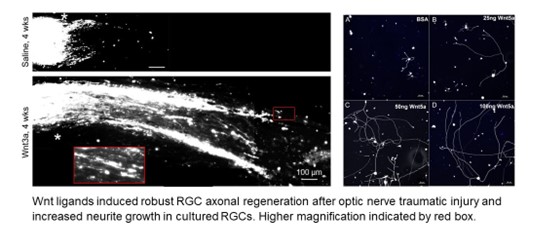
Current research topics in the Retinal Restoration Laboratory include investigating the role of innate immunity in retinal degenerations, characterizing protective effects of the Wnt signaling pathway in optic nerve regeneration and photoreceptor diseases, and determining the effect of specific dietary interventions on rescuing vision in ocular disease.
-
The role of innate immunity in retinal degeneration
-
Identification of optic nerve regeneration factors
-
High throughput drug discovery for identifying neuroprotective factors
-
Investigating the contribution of diet and environmental factors to ocular disease
-
Identification of photoreceptor protective proteins: the role of the Wnt signaling pathways in retinal degeneration.
 Dysregulated inflammation contributes to retinal degeneration. A central challenge for developing new inflammatory control therapies for retinal degenerations is to selectively suppress detrimental inflammation while maintaining beneficial inflammatory responses. Over the past decade, we have demonstrated that photoreceptor survival can be controlled by manipulating various innate immunity pathways, including Toll-like receptors 3 and 4, MyD88 and the IL-27 cytokine. Current research topics include exploring mechanisms by which innate immunity signals regulate neuronal-glial interactions, determining how endogenous tissue protective signals are affected by TLRs, identifying molecules that alter polarization of inflammatory cells to neurorestorative phenotypes, characterizing the role of innate immunity receptors in neuronal cells, and determining how innate immune pathways are regulated by oxidative stress levels. Experimental approaches include proteomics, bioinformatics, in vivo and in vitro models, biochemical, cellular and molecular biology techniques. These studies will provide insight into how inflammation and neuroprotective signaling are regulated during retinal degeneration and set the foundation for developing new therapies to protecting photoreceptors and rescuing vision.
 We have developed a Muller glia-photoreceptor primary culture system that enables us to test novel compounds that regulate photoreceptor survival. We have used this system to identify protective effects of innate immunity inhibitors and activators of the canonical Wnt signaling pathway.
 Environment and genetics interact in complex ways to influence inflammation and neuronal survival in the retina. Ongoing studies are investigating how specific diets, such as ketogenic and lyophilized grape supplement, influence tissue intrinsic responses to injury and act to delay vision loss. Additionally, we are interested in how environmental pollutants alter inflammatory markers in ocular surface disease.