
Endovascular aneurysm repair is a minimally invasive way to reinforce a weakened area of the aorta without opening the chest or abdomen. Using small groin incisions and imaging guidance, our surgeons place a stent‑graft inside the aorta to re‑line the vessel and redirect blood flow away from the aneurysm.
At UHealth – University of Miami Health System, our vascular and cardiothoracic teams offer EVAR for abdominal aortic aneurysms and TEVAR for descending thoracic aortic aneurysms, alongside open and hybrid approaches, so your plan is tailored to your anatomy and goals.
Advanced Endovascular Techniques
Our vascular and cardiac surgeons use some of the most advanced tools available to make aneurysm repair as safe and effective as possible.
Smaller Incisions for Faster Recovery
Whenever possible, we use needle-sized incisions in the groin instead of larger cuts. This can mean less discomfort and quicker healing.
Custom Stent-Grafts
Some aneurysms involve arteries that supply blood to the kidneys or other organs. For these cases, we use specially designed stent-grafts with tiny openings (fenestrated or branched) so blood keeps flowing where it's needed.
High-Tech Imaging
Our operating rooms are equipped with advanced imaging systems that let surgeons see your arteries in real time, ensuring the stent-graft is placed with precision.
These innovations allow us to treat more complex aneurysms with minimally invasive approaches, helping patients recover sooner and with fewer complications.
Who Is a Candidate?
You may be a candidate for aneurysm repair if:
- Your aneurysm is large or growing and meets the medical guidelines for treatment.
- There is enough healthy aorta above and below the aneurysm to safely attach and seal the stent graft.
- Your blood vessel anatomy is a good fit for the type of stent graft needed (standard, fenestrated, or branched).
- You are healthy enough to undergo anesthesia and the procedure.
We verify your candidacy using CT angiography and review whether an open or hybrid approach better aligns with your objectives.
How EVAR/TEVAR Works
Endovascular repair is a minimally invasive way to treat aneurysms without open chest or belly surgery. Instead of a large incision, doctors use small cuts in the groin to reach the aorta through your blood vessels.
Here's the process:
- Small groin incisions: The surgical team places thin tubes (catheters) into the arteries.
- Guided by imaging: Using real-time X-rays, doctors guide the tubes to the aneurysm.
- Stent-graft placement: A fabric-covered metal tube (stent-graft) is positioned inside the aorta. Once in place, it opens up and creates a new path for blood flow.
- Protecting the aneurysm: Blood now flows through the stent-graft instead of pressing on the weakened aneurysm wall, lowering the risk of rupture. Over time, the aneurysm sac may shrink.
Types of repairs:
- EVAR is for aneurysms in the belly (abdominal aortic aneurysms).
- TEVAR is for aneurysms in the chest (thoracic aortic aneurysms).
- For aneurysms in the upper part of the aorta (near the heart), open surgery is usually recommended.
Hybrid Aortic Surgery
Some aneurysms are too complex to fix with a stent alone. In these cases, doctors may use hybrid surgery, which combines open surgery with endovascular repair.
When It's Used
- If the aneurysm involves arteries that supply blood to the brain, kidneys, or other vital organs
- If your anatomy makes standard endovascular repair difficult
- If you've had prior stent-grafts and need additional treatment
How It Works
- First, surgeons reroute (or "reconnect") some blood vessels to make sure organs keep getting the blood they need.
- Next, they place a stent-graft inside the aorta to repair the aneurysm.
- This can sometimes be done in one surgery, or in two stages depending on your needs.
Benefits
- Makes minimally invasive repair possible for more patients
- Protects critical organs
- Allows for a personalized recovery plan
What to Expect
Before the Procedure
We take time to prepare you thoroughly and make sure treatment is as safe as possible. Preparation often includes:
- Detailed imaging and lab work: A CT angiogram shows us the exact size and shape of your aneurysm so we can design the best-fit stent-graft.
- Medication review: We'll go over all your medicines, including blood thinners, and check kidney function since contrast dye is used during the procedure.
- Clear instructions: You'll receive specific guidance about hydration, fasting, and any medication changes before surgery.
During the Procedure
- You'll receive general anesthesia (you're fully asleep) or regional anesthesia (numbing from the waist down).
- Through tiny groin incisions, surgeons guide slim tubes (catheters) into the arteries to position the stent-graft.
- Live imaging with contrast dye ensures the stent-graft is sealed tightly above and below the aneurysm.
After the Procedure (Hospital Stay)
- You'll be monitored closely for bleeding, kidney function, and healing at the incision sites.
- Early walking is encouraged—often the same day or next—to help prevent complications.
- Most people leave the hospital within 1–3 days and return to light activities within 1–2 weeks.
Recovery Timeline (Typical)
- Weeks 1–2: Focus on incision care, light activity, and avoiding heavy lifting. Soreness usually improves quickly.
- By 4–6 weeks: Many patients are back to normal routines if cleared by their surgeon.
- By 3 months: Most restrictions are lifted. We'll encourage long-term heart- and vessel-healthy habits.
Risks and How We Lower Them
Every procedure has risks, but our team uses advanced strategies to reduce them:
- Endoleak or graft movement: Minimized with careful planning and early detection through scheduled imaging.
- Bleeding or vessel injury at the access site: Reduced with newer "percutaneous" (needle-based) techniques and closure devices.
- Kidney stress from contrast dye: Managed with hydration and dye-sparing methods.
- Stroke or spinal cord issues (for large thoracic aneurysms): Addressed with targeted blood-pressure management and protective measures.
- Infection or clotting: Prevented with antibiotics, careful monitoring, and early mobility.
Frequently Asked Questions
Our Location
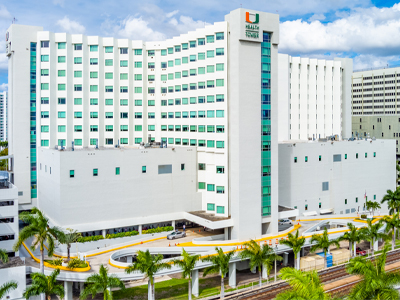
Cardiac Surgery at UHealth Tower
1400 Northwest 12th Avenue, Suite 1
Miami, FL 33136
Get Directions
Our Experts
Why Choose UHealth for EVAR/TEVAR
Expertise You Can Trust. One of the region's highest-volume endovascular programs with deep experience in complex cases.
Advanced Technologies. Access to fenestrated and branched stent-grafts, plus innovations from leading academic medicine.
Comprehensive Care Under One Roof. Hybrid operating rooms, imaging, and collaborative planning by a multidisciplinary team.
Structured Follow-Up. A clear surveillance plan designed to protect your long-term health.
End-to-End Support. From fast diagnosis to treatment, recovery, and lifelong monitoring, we're with you at every step.
Schedule an Appointment
If you or a loved one has been diagnosed with an aortic aneurysm, aortic dissection, or another aortic condition, our team is ready to help.