
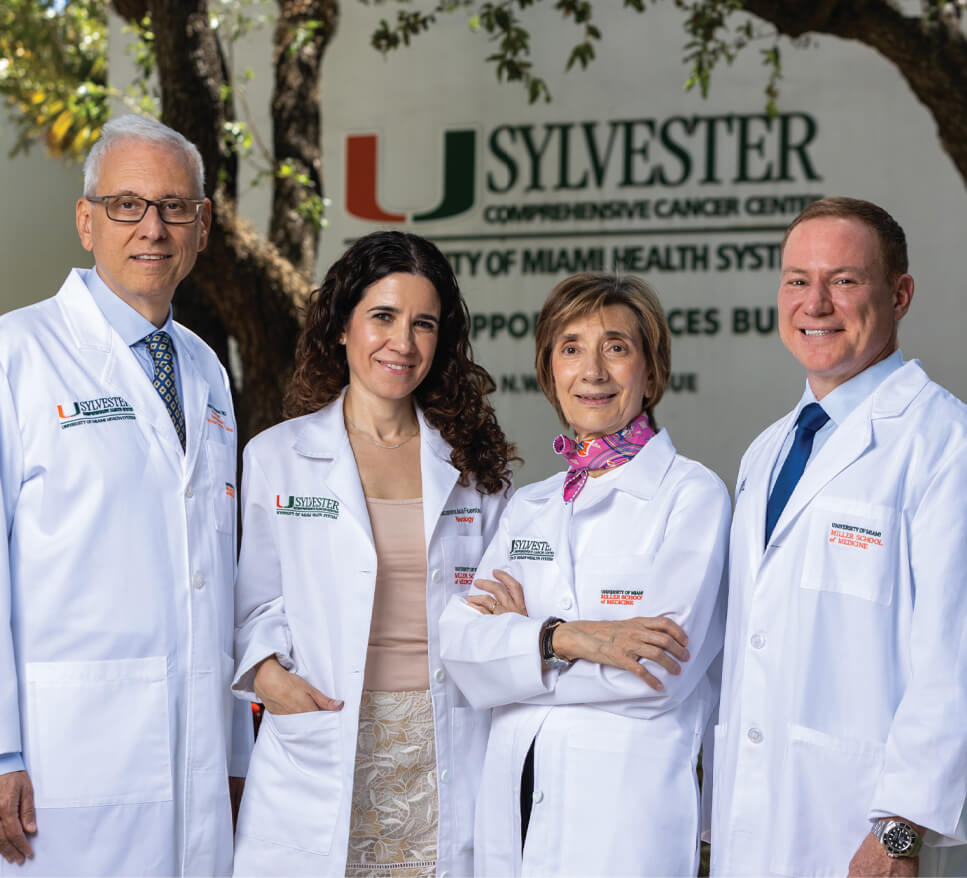
 The Sylvester Brain Tumor Institute leadership team (from left):
Dr. Antonio Iavarone, Dr. Macarena de la Fuente, Dr. Anna Lasorella
and Dr. Ricardo Komotar
The Sylvester Brain Tumor Institute leadership team (from left):
Dr. Antonio Iavarone, Dr. Macarena de la Fuente, Dr. Anna Lasorella
and Dr. Ricardo KomotarThe research on malignant brain tumors is rising to a whole new level. In 2024, Sylvester launched the Sylvester Brain Tumor Institute (SBTI) to advance brain cancer care and research. With a Brain Tumor Initiative for many years that provided research and clinical care, Sylvester moved forward to establish the SBTI to elevate brain cancer care and research in South Florida and beyond.
SBTI's mission is to foster collaboration across multiple disciplines, uniting experts from various fields to tackle glioblastoma and other complex brain cancers. Glioblastoma, a highly aggressive and difficult-to-treat cancer, has a survival rate of just 12 to 18 months, making it a primary focus of the institute.
Under the leadership of Antonio Iavarone, M.D., director, the institute brings together multidisciplinary teams of clinicians, surgeons and scientists to develop personalized treatments.
The team is creating patient-specific laboratory models using biopsied tissue to generate patient-derived organoids and xenografts.
These models allow for detailed studies and drug testing, enabling precision treatments tailored to the unique characteristics of each tumor, thereby enhancing clinical trial outcomes and patient care.
SBTI leadership also includes three co-directors – Macarena de la Fuente, M.D., Ricardo Komotar, M.D., and Anna Lasorella, M.D., who is also director of Sylvester's Precision Medicine Initiative. Together, they lead a comprehensive approach to brain tumor research and treatment.
A key focus of the institute is understanding the evolution of glioblastoma after treatment, specifically how tumors develop resistance and recur.
By identifying biomarkers and tailoring therapies accordingly, SBTI aims to offer more personalized, effective treatments and expedite the approval of new therapies.
The establishment of SBTI marks a significant step forward in Sylvester's commitment to improving brain cancer treatment in South Florida, combining leading-edge research, personalized care and clinical innovation to achieve better patient outcomes.
UNMASKING GLIOBLASTOMA RESISTANCE
Collaborative research is also a cornerstone for SBTI, which will continue to build on areas of study. Earlier in the year, a remarkable discovery found that cancer cells are adept at evading treatment by disguising themselves as healthy cells. Glioblastoma, an incurable brain cancer, can mimic human neurons, even growing axons and forming connections with healthy neurons, which contributes to its resistance to drugs.
A study from Sylvester and its collaborators found that this neuron mimicry is key to the cancer's treatment resistance. The researchers also identified a class of therapeutics, BRAF inhibitors, that could prevent tumors from becoming drug-resistant.
Co-led by Dr. Iavarone, the study used a unique platform to analyze glioblastoma cells' proteomes, or complete protein sets. This approach allowed them to spot modifications in proteins that indicate enzyme activity, offering insights beyond genetic data alone.
By studying tumor samples from 123 glioblastoma patients, both at diagnosis and after recurrence, the team created the largest dataset of its kind. This allowed them to identify crucial changes that drive treatment resistance.
The researchers focused on kinases, enzymes that regulate protein activity. Using machine learning, they identified BRAF as a key kinase involved in glioblastoma's resistance. Unlike in other cancers, BRAF protein levels increase in glioblastoma without mutations in the gene itself. This discovery would not have been possible without analyzing the cancer proteome.
Dr. Iavarone hopes this proteomic approach can lead to nextgeneration precision therapies for glioblastoma and other resistant cancers.