Skip to Main Content
  • UHealth |
  • Bascom Palmer Eye Institute

New Anti-Cancer Strategy Uses RNA to Ferry Chemo into Tumors

Sylvester Comprehensive Cancer Center
  • Appointments
  • Locations
  • Pay a Bill
  • Refer a Patient
  • International Patients
  • Donate Now
  • Search
  • Patient Login
  • Find a Doctor
  • Cancer Types & Treatments Page 1
    Cancer Types
    • Basal Cell Skin Cancer of the Eye
    • Benign Eye Diseases
    • Bladder Cancer
    • Bone and Soft Tissue Sarcoma
    • Brain and Spine Tumors
    • Breast Cancer
    • Colorectal Cancer
    • Cysts and Tumors of the Pleura
    • Endocrine Cancers
    • Eye and Ocular Cancer
    • Genitourinary Cancers
    • Glioblastoma
    • Gynecologic Cancers
    • Head and Neck Cancers
    • Hematologic (Blood) Cancers
    • Hodgkin Lymphoma
    • Leukemia
    • Liver Cancer
    • Lung and Chest Cancer
    • Melanoma and Merkel Cell Carcinomas
    • Multiple Myeloma
    • Non-Hodgkin Lymphoma
    • Ocular Lymphoma
    • Pancreatic Cancer
    • Pediatric Cancers
    • Prostate Cancer
    • Skin Cancers
    • Bone and Soft Tissue Sarcoma
    • Stomach Cancer
    • Thyroid Cancer
    View all Cancer Types
    Treatments
    • Bone Marrow and Stem Cell Transplant
    • Breast Reconstruction
    • CAR T-cell Therapy
    • Gamma Knife Radiosurgery
    • Hyperthermic Intraperitoneal and Intrapleural Chemotherapy (HIPEC)
    • Laser Ablation
    • Laser Interstitial Thermal Therapy
    • Minimally Invasive Brain Tumor Surgery
    • Precision Medicine
    • Proton Therapy
    • Radiation Therapy
    • Radioactive Iodine Therapy
    Cancer Types
    • Basal Cell Skin Cancer of the Eye
    • Benign Eye Diseases
    • Bladder Cancer
    • Bone and Soft Tissue Sarcoma
    • Brain and Spine Tumors
    • Breast Cancer
    • Colorectal Cancer
    • Cysts and Tumors of the Pleura
    • Endocrine Cancers
    • Eye and Ocular Cancer
    • Genitourinary Cancers
    • Glioblastoma
    • Gynecologic Cancers
    • Head and Neck Cancers
    • Hematologic (Blood) Cancers
    • Hodgkin Lymphoma
    • Leukemia
    • Liver Cancer
    • Lung and Chest Cancer
    • Melanoma and Merkel Cell Carcinomas
    • Multiple Myeloma
    • Non-Hodgkin Lymphoma
    • Ocular Lymphoma
    • Pancreatic Cancer
    • Pediatric Cancers
    • Prostate Cancer
    • Skin Cancers
    • Bone and Soft Tissue Sarcoma
    • Stomach Cancer
    • Thyroid Cancer
    View all Cancer Types
  • Patients & Families
    For Patients & Families
    • Your First Visit
    • Parking Information
    • Frequently Asked Questions
    • Classes & Events
    • Nurse Navigators
    • Interpreter Services
    • Clinical Trials
    • International Patients
    • Medical Records
    • Quality and Patient Safety
    • Patient Educational Materials
    • Advance Directives
    • Bereavement Support

    Cancer Prevention & Screening
    • Why Get Screened?
    • Hereditary Cancer Risk
    • Breast Cancer Screening
    • Cervical Cancer Screening
    • Colorectal Cancer Screening
    • Lung Cancer Screening
    • Prostate Cancer Screening
    • Skin Cancer Screening
    • Stomach Cancer Screening
    • Lifestyle Medicine
    Cancer Supportive Care
    • Classes & Events
    • Acupuncture
    • Adolescent and Young Adult (Ages 15-39) Program
    • Art Therapy
    • Emotional and Mental Well-Being
    • Exercise Oncology
    • Massage Therapy
    • Music Therapy
    • Nutrition
    • Oncology Social Work Services
    • Spiritual Care
    • Support Groups & Programs
    • Wigs and Head Coverings
    • Yoga Therapy
    • View All Cancer Supportive Care
    Cancer Survivorship Care
    • Cancer Survivorship & Supportive Care Institute
    • Survivorship Care
    • Survivorship FAQs
    • Your Survivorship Information
    • Cancer Supportive Care
    • Survivorship News
    • Education & Events
    • Institute Leadership
    • Survivorship Team
    • Survivorship And Supportive Care Research

    Quick Links

    • Appointments
    • Find a Doctor
    • Pay a Bill
    • Insurance Plans Accepted
    • MyUHealthChart
    Donate Today
    Quick links
    • Appointments
    • Find a Doctor
    • Pay a Bill
    • Make a Gift
    • Insurance Plans Accepted
    • MyUHealthChart
    For Patients & Families
    • Your First Visit
    • Parking Information
    • Frequently Asked Questions
    • Classes & Events
    • Nurse Navigators
    • Interpreter Services
    • Clinical Trials
    • International Patients
    • Medical Records
    • Quality and Patient Safety
    • Patient Educational Materials
    • Advance Directives

    Cancer Prevention & Screening
    • Why Get Screened?
    • Hereditary Cancer Risk
    • Breast Cancer Screening
    • Cervical Cancer Screening
    • Colorectal Cancer Screening
    • Lung Cancer Screening
    • Prostate Cancer Screening
    • Skin Cancer Screening
    • Stomach Cancer Screening
    • Lifestyle Medicine
    Cancer Supportive Care
    • Classes & Events
    • Acupuncture
    • Adolescent and Young Adult (Ages 15-39) Program
    • Art Therapy
    • Emotional and Mental Well-Being
    • Exercise Oncology
    • Massage Therapy
    • Music Therapy
    • Nutrition
    • Oncology Social Work Services
    • Spiritual Care
    • Support Groups & Programs
    • Wigs and Head Coverings
    • Yoga Therapy
    • View All Cancer Supportive Care
    Cancer Survivorship Care
    • Cancer Survivorship & Supportive Care Institute
    • Survivorship Care
    • Survivorship FAQs
    • Your Survivorship Information
    • Cancer Supportive Care
    • Survivorship News
    • Education & Events
    • Institute Leadership
    • Survivorship Team
    • Survivorship And Supportive Care Research
    About Sylvester
    • Why Choose Sylvester
    • Message from the Director
    • NCI-Designated Cancer Center
    • Cancer Center of Excellence
    • Our History
    • Mission, Vision & Values
    • Facts and Figures
    • Impact Reports
    • Leadership
    • Partners in Our Mission
    • Careers
    • Cancer Center Volunteers
    • Make a Gift
    • Health News
    • Contact Us
  • Research
    Clinical Trials
    • Find a Clinical Trial
    • Understanding Clinical Trials
    • Clinical Trials FAQ's
    • Phase 1 Clinical Trials
    About Our Research
    • Research Programs
    • Engineering Cancer Cures
    • Faculty
    • Labs
    Research Resources
    • Clinical Research Services
    • Shared Resources
    • Data Science
    • SCAN 360
    • Funding Opportunities
    • Tumor Registry
     
    • Medical Library
    • Grant Writing Support
    • Human Subject Research Office
    • Regulatory Oversight
    • IACUC
    • Responsible Conduct of Research (RCR)
    Clinical Trials
    • Find a Clinical Trial
    • Understanding Clinical Trials
    • Clinical Trials FAQ's
    • Phase 1 Clinical Trials
    About Our Research
    • Research Programs
    • Engineering Cancer Cures
    • Faculty
    • Labs
    Research Resources
    • Clinical Research Services
    • Shared Resources
    • Data Science
    • SCAN 360
    • Funding Opportunities
    • Tumor Registry
    • Medical Library
    • Grant Writing Support
    • Human Subject Research Office
    • Regulatory Oversight
    • IACUC
    • Responsible Conduct of Research (RCR)
  • Education and Training
    Education and Training
    • About Us
    • High School, Undergraduate, & Postbaccalaureate Students
    • Medical Students
    • Graduate Program
    • Postdoctoral Training
    • Clinical Fellowships
     
    • Faculty Development
    • Events Calendar
    Education and Training
    • About Us
    • High School, Undergraduate, & Postbaccalaureate Students
    • Medical Students
    • Graduate Program
    • Postdoctoral Training
    • Clinical Fellowships
    • Faculty Development
    • Events Calendar
  • Community Engagement
    Community Outreach Activity
    • What We Do
    • Game Changer Vehicles
    • Request Our Services
    • Who We Are
    • The Area We Serve
    • Community Partnerships
    • Unite Us
    • Community Advisory Committee (CAC)
    • Partnership Matching Request Form
    • Spotlight Corner
    Community Engagement
    • Firefighter Cancer Initiative
    • Global Oncology
    • World Health Organization
    • Avanzando Caminos: Hispanic/Latino Cancer Survivorship Cohort Study
    Community Outreach Activity
    • What We Do
    • Game Changer Vehicles
    • Request Our Services
    • Who We Are
    • The Area We Serve
    • Community Partnerships
    • Unite Us
    • Community Advisory Committee (CAC)
    • Partnership Matching Request Form
    • Spotlight Corner
    Community Engagement
    • Firefighter Cancer Initiative
    • Global Oncology
    • World Health Organization
    • Avanzando Caminos: Hispanic/Latino Cancer Survivorship Cohort Study
  • About Sylvester
    About Sylvester
    • Why Choose Sylvester
    • Message from the Director
    • NCI-Designated Cancer Center
    • Cancer Center of Excellence
    • Our History
    • Mission, Vision & Values
    • Facts and Figures
    • Impact Reports
     
    • Leadership
    • Partners in Our Mission
    • Careers
    • Cancer Center Volunteers
    • Make a Gift
    • Health News
    • Contact Us
    About Sylvester
    • Why Choose Sylvester
    • Message from the Director
    • NCI-Designated Cancer Center
    • Cancer Center of Excellence
    • Our History
    • Mission, Vision & Values
    • Facts and Figures
    • Impact Reports
    • Leadership
    • Partners in Our Mission
    • Careers
    • Cancer Center Volunteers
    • Make a Gift
    • Health News
    • Contact Us
Patient Login
  • University of Miami Health System
  • Sylvester Comprehensive Cancer Center
  • Impact Reports
  • Accomplishments Report - 2020
  • Research Highlights
  • New Anti-Cancer Strategy Uses RNA to Ferry Chemo into Tumors

New Anti-Cancer Strategy Uses RNA to Ferry Chemo into Tumors

View All Reports
« Back to Research Highlights
Accomplishments Report - 2020
  • Responding to COVID-19
  • Message from the Director
  • Board Chair and Vice Chairs
  • Leadership
  • Sylvester by the Numbers
  • Recruits and New Appointments
    • Internationally Known Eye Cancer Researcher Joins Sylvester and Bascom Palmer
    • Dr. Macarena de la Fuente Named Neuro-Oncology Clinical Service Leader and Chief of Neuro-Oncology Division
    • World-Renowned Multiple Myeloma Expert Joins Sylvester Leadership
    • Storyteller Will Help Sylvester Write Next Chapter in Hematology
    • New Physicians and Researchers
  • Key Grants and Other Funding
    • NCI Grant Funds Disparities and Equity Training Project at Sylvester
    • Sylvester Receives NCI Supplement Award for CATCH-UP.2020
    • NCI Grant Funds Study of Combination Therapy for Pancreatic Cancer
    • Sylvester Researchers Receive Grants From the State of Florida
    • Breast Cancer Researcher Receives Grant from the V Foundation and Miami Dolphins
    • Sylvester Urologic Researcher Receives AUA Funding for Two-Year Research Project
  • Research Highlights
    • Artificial Intelligence Provides Game-Changing Intraoperative Brain Tumor Diagnostics
    • First Single-Cell Analysis of Uveal Melanoma
    • Deciphering Genetics by Studying GI Cancer Patients with “Extreme Outlier” Outcomes
    • Targeted Chemotherapy for Treatment-Resistant Tumor Cells
    • New Anti-Cancer Strategy Uses RNA to Ferry Chemo into Tumors
    • Sylvester Urologist Leads Collaborative Study on Fertility Counseling Prior to Chemotherapy
    • Culturally Relevant Programs Needed to Help End Hep B in Black Communities, Sylvester Researchers Report
    • Positive Results for New Treatment Strategy for Localized Prostate Cancer
    • Nanoparticle Delivery Can Enhance Chemotherapy for Aggressive Lymphomas
    • Sylvester Study Contributed to FDA Approval of Targeted Therapy for Lung Cancer
    • Waking Cancer Cells to Eliminate Them
  • Achievements and Honors
    • Sylvester Opens the Dwoskin Proton Therapy Center
    • Sylvester Researcher Wins International Award for Discoveries Leading to Advances in Immunotherapy
    • Dr. Erin Kobetz Named Vice Chair of State Advisory Council
    • Dr. Krishna Komanduri Welcomed into Prestigious Society for Immunologists
    • Sylvester Oncologist Receives Women in Sarcoma Award
    • Sylvester’s Radiation Oncology Team Earns Prestigious Press Ganey Award
    • Sylvester Surgeon Receives Prestigious Research Fellowship
    • Dr. Donna Lundy Wins Prestigious Award from American Cancer Society
    • 2020 Zubrod Memorial Lecture and Outstanding Faculty Awards
  • Public Health and Community Outreach
    • Sylvester Hosts Second National Firefighter Cancer Symposium
    • Sylvester Researchers Study COVID-19 Antibodies in First Responders
  • Cancer Survivorship
  • Partners in Our Mission
    • Transformational $126 Million Gift Propels Sylvester into New Chapter of Excellence
    • The Dolphins Challenge Cancer: A Decade of the DCC Ushers in a New Era of Fundraising
    • Braman Family Foundation Renews Commitment to Fight Breast Cancer
    • Woman’s Cancer Association Continues Legacy of Support to Sylvester
    • Philanthropy During the COVID-19 Pandemic

In a study published in Science Translational Medicine, researchers at Sylvester, along with colleagues at the University of Modena and Reggio Emilia, and Verona University Hospital in Italy, have demonstrated that a relatively new class of RNA molecules, called aptamers, can successfully guide chemotherapy into tumors. This research, conducted in animal models, could lead to advanced therapeutics that specifically target cancers while leaving healthy tissues alone.

The research article, “Aptamers against mouse and human tumor-infiltrating myeloid cells as reagents for targeted chemotherapy,” was released online on June 17.
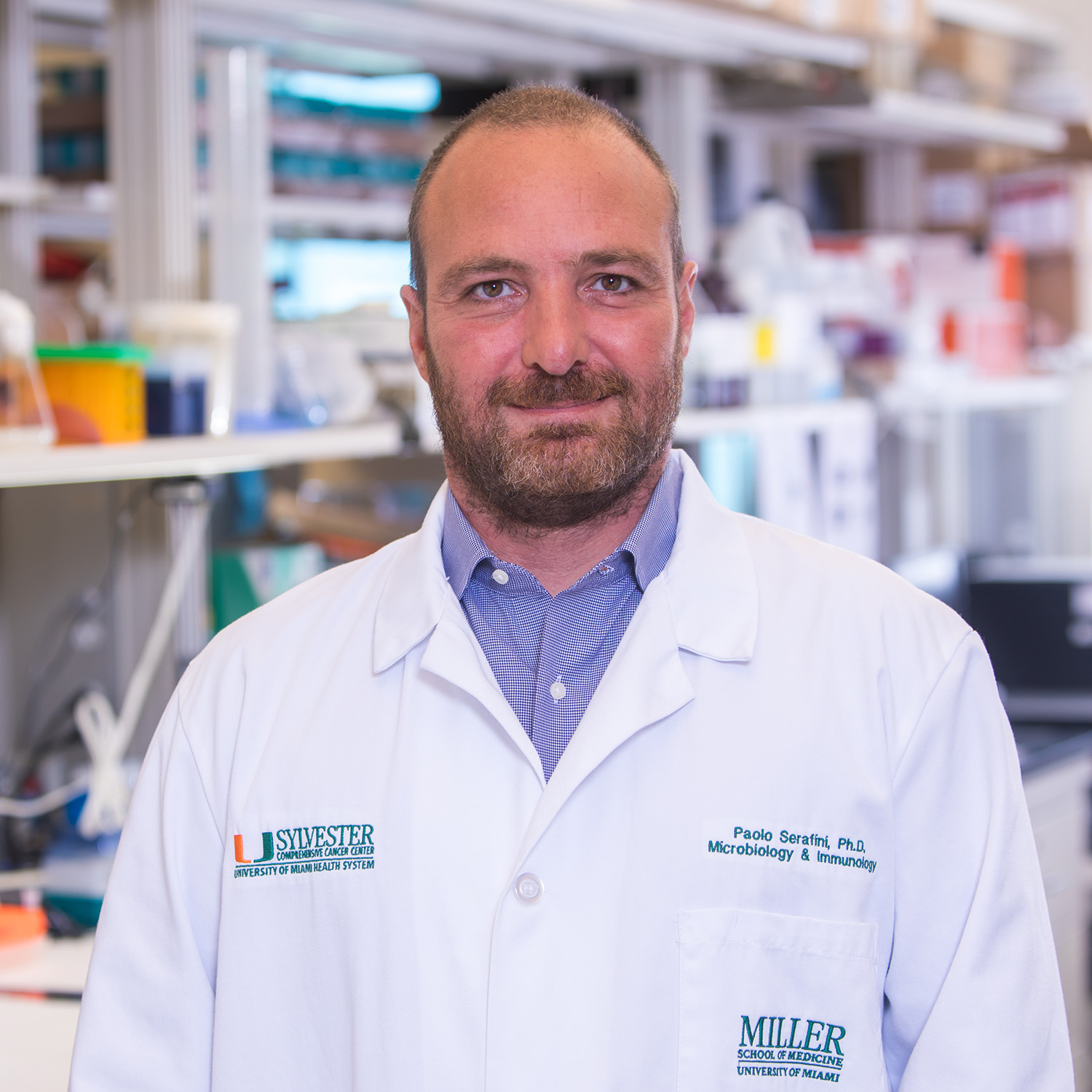
Paolo Serafini, Ph.D.
Paolo Serafini, Ph.D. 

“Chemotherapies are the first line of treatment for most cancers,” said Paolo Serafini, Ph.D., research assistant professor in the Department of Microbiology and senior author on the paper. “While they are effective treatments, they can also cause both short- and long-term damage to the body. Our goal was to make chemotherapy more intelligent, more effective and less toxic.”

Cancer researchers have been investigating targeted treatments for decades, often conjugating antibodies with therapeutic molecules to attack tumors. Unfortunately, these targeting antibodies are challenging to make, and cancer cells can evolve mechanisms to elude them.

To overcome these faults, the Serafini lab adapted RNA aptamers, instead of antibodies, to target rogue immune cells, called myeloid-derived suppressor cells (MDSCs). Tumors recruit these cells to suppress the immune response, making them cancer’s best friend. Because MDSCs have unique molecular features, do not evolve resistance and are ubiquitous inside tumors, they could also be handy therapeutic targets.

“Unlike tumor cells, which are quite heterogeneous, MDSCs are similar to each other within a patient, across patients and across cancer types.” Dr. Serafini said. “At the tumor sites, these cells acquire a unique phenotype that makes them different from all other cells in the body. As a result, they can mark where the tumor and metastases are located.”

Taking advantage of these traits, the Serafini lab investigated whether RNA aptamers, which can fold into different shapes and bind to diverse cell surface molecules, can effectively target MDSCs. Using a relatively simple chemical process, the lab synthesized 1015 aptamers. From these they isolated several that could be used to target MDSCs.

“We identified four RNA aptamers that specifically recognized MDSCs in the primary tumor and metastases but not the ones in healthy organs,” Dr. Serafini said.

They then conjugated chemotherapy (doxorubicin) molecules to the aptamers and tested them in animal models for breast cancer. This new formulation outperformed standard doxorubicin and showed little toxicity.

Developing RNA aptamers to direct therapeutic molecules to tumors could be a major breakthrough, as they are easier to manufacture than antibodies and may be more effective.

“They work like antibodies, but you don’t need cells to produce them,” Dr. Serafini said. “You don’t need big incubators; you can just do it chemically with an oligo synthesizer (an instrument that manufactures genetic material). They are tiny, so they can go deep into tissues, and we don’t need to humanize them, because they are not recognized by the immune system and are not immunogenic.”


logo--sylvester

NCI Designated

USNWR Cancer 2025-2026 Badge

Cancer Center of Excellence
Quick links
  • Appointments
  • Find a Doctor
  • Pay a Bill
  • Make a Gift
  • Insurance Plans Accepted
  • MyUHealthChart

Patient & Families
  • Cancer Treatments
  • Cancer Supportive Care
  • Your First Visit
  • Frequently Asked Questions
  • Nurse Navigators
  • Interpreter Services
  • Clinical Trials
  • International Patients
  • Medical Records
  • Price Transparency
  • Florida Health Finder
Research
  • Research at Sylvester
  • Research Programs
  • Research Labs & Faculty
  • Clinical Research Services
  • Shared Resources
  • Clinical Fellowship
  • Community Outreach Activity
About Sylvester
  • Why Choose Sylvester
  • NCI-Designated Cancer Center
  • Cancer Center of Excellence
  • Our History
  • Impact Reports
  • Mission, Vision & Values
  • Quality and Patient Safety
  • Leadership
  • Careers
  • Volunteers
  • For Media
  • Contact Us
  • Make a Gift

University of Miami Centennial Logo

Medical Disclaimer | Terms of Use | Privacy Statement | HIPAA Notice of Privacy Practices | For Employees
© 2025 University of Miami Health System. All rights reserved.