Skip to Main Content
  • UHealth |
  • Bascom Palmer Eye Institute

Transitional Bereavement Care Model

Sylvester Comprehensive Cancer Center
  • Appointments
  • Locations
  • Pay a Bill
  • Refer a Patient
  • International Patients
  • Donate Now
  • Search
  • Patient Login
  • Find a Doctor
  • Cancer Types & Treatments Page 1
    Cancer Types
    • Basal Cell Skin Cancer of the Eye
    • Benign Eye Diseases
    • Bladder Cancer
    • Bone and Soft Tissue Sarcoma
    • Brain and Spine Tumors
    • Breast Cancer
    • Colorectal Cancer
    • Cysts and Tumors of the Pleura
    • Endocrine Cancers
    • Eye and Ocular Cancer
    • Genitourinary Cancers
    • Glioblastoma
    • Gynecologic Cancers
    • Head and Neck Cancers
    • Hematologic (Blood) Cancers
    • Hodgkin Lymphoma
    • Leukemia
    • Liver Cancer
    • Lung and Chest Cancer
    • Melanoma and Merkel Cell Carcinomas
    • Multiple Myeloma
    • Non-Hodgkin Lymphoma
    • Ocular Lymphoma
    • Pancreatic Cancer
    • Pediatric Cancers
    • Prostate Cancer
    • Skin Cancers
    • Bone and Soft Tissue Sarcoma
    • Stomach Cancer
    • Thyroid Cancer
    View all Cancer Types
    Treatments
    • Bone Marrow and Stem Cell Transplant
    • Breast Reconstruction
    • CAR T-cell Therapy
    • Gamma Knife Radiosurgery
    • Hyperthermic Intraperitoneal and Intrapleural Chemotherapy (HIPEC)
    • Laser Ablation
    • Laser Interstitial Thermal Therapy
    • Minimally Invasive Brain Tumor Surgery
    • Precision Medicine
    • Proton Therapy
    • Radiation Therapy
    • Radioactive Iodine Therapy
    Cancer Types
    • Basal Cell Skin Cancer of the Eye
    • Benign Eye Diseases
    • Bladder Cancer
    • Bone and Soft Tissue Sarcoma
    • Brain and Spine Tumors
    • Breast Cancer
    • Colorectal Cancer
    • Cysts and Tumors of the Pleura
    • Endocrine Cancers
    • Eye and Ocular Cancer
    • Genitourinary Cancers
    • Glioblastoma
    • Gynecologic Cancers
    • Head and Neck Cancers
    • Hematologic (Blood) Cancers
    • Hodgkin Lymphoma
    • Leukemia
    • Liver Cancer
    • Lung and Chest Cancer
    • Melanoma and Merkel Cell Carcinomas
    • Multiple Myeloma
    • Non-Hodgkin Lymphoma
    • Ocular Lymphoma
    • Pancreatic Cancer
    • Pediatric Cancers
    • Prostate Cancer
    • Skin Cancers
    • Bone and Soft Tissue Sarcoma
    • Stomach Cancer
    • Thyroid Cancer
    View all Cancer Types
  • Patients & Families
    For Patients & Families
    • Your First Visit
    • Parking Information
    • Frequently Asked Questions
    • Classes & Events
    • Nurse Navigators
    • Interpreter Services
    • Clinical Trials
    • International Patients
    • Medical Records
    • Quality and Patient Safety
    • Patient Educational Materials
    • Advance Directives
    • Bereavement Support

    Cancer Prevention & Screening
    • Why Get Screened?
    • Hereditary Cancer Risk
    • Breast Cancer Screening
    • Cervical Cancer Screening
    • Colorectal Cancer Screening
    • Lung Cancer Screening
    • Prostate Cancer Screening
    • Skin Cancer Screening
    • Stomach Cancer Screening
    • Lifestyle Medicine
    Cancer Supportive Care
    • Classes & Events
    • Acupuncture
    • Adolescent and Young Adult (Ages 15-39) Program
    • Art Therapy
    • Emotional and Mental Well-Being
    • Exercise Oncology
    • Massage Therapy
    • Music Therapy
    • Nutrition
    • Oncology Social Work Services
    • Spiritual Care
    • Support Groups & Programs
    • Wigs and Head Coverings
    • Yoga Therapy
    • View All Cancer Supportive Care
    Cancer Survivorship Care
    • Cancer Survivorship & Supportive Care Institute
    • Survivorship Care
    • Survivorship FAQs
    • Your Survivorship Information
    • Cancer Supportive Care
    • Survivorship News
    • Education & Events
    • Institute Leadership
    • Survivorship Team
    • Survivorship And Supportive Care Research

    Quick Links

    • Appointments
    • Find a Doctor
    • Pay a Bill
    • Insurance Plans Accepted
    • MyUHealthChart
    Donate Today
    Quick links
    • Appointments
    • Find a Doctor
    • Pay a Bill
    • Make a Gift
    • Insurance Plans Accepted
    • MyUHealthChart
    For Patients & Families
    • Your First Visit
    • Parking Information
    • Frequently Asked Questions
    • Classes & Events
    • Nurse Navigators
    • Interpreter Services
    • Clinical Trials
    • International Patients
    • Medical Records
    • Quality and Patient Safety
    • Patient Educational Materials
    • Advance Directives

    Cancer Prevention & Screening
    • Why Get Screened?
    • Hereditary Cancer Risk
    • Breast Cancer Screening
    • Cervical Cancer Screening
    • Colorectal Cancer Screening
    • Lung Cancer Screening
    • Prostate Cancer Screening
    • Skin Cancer Screening
    • Stomach Cancer Screening
    • Lifestyle Medicine
    Cancer Supportive Care
    • Classes & Events
    • Acupuncture
    • Adolescent and Young Adult (Ages 15-39) Program
    • Art Therapy
    • Emotional and Mental Well-Being
    • Exercise Oncology
    • Massage Therapy
    • Music Therapy
    • Nutrition
    • Oncology Social Work Services
    • Spiritual Care
    • Support Groups & Programs
    • Wigs and Head Coverings
    • Yoga Therapy
    • View All Cancer Supportive Care
    Cancer Survivorship Care
    • Cancer Survivorship & Supportive Care Institute
    • Survivorship Care
    • Survivorship FAQs
    • Your Survivorship Information
    • Cancer Supportive Care
    • Survivorship News
    • Education & Events
    • Institute Leadership
    • Survivorship Team
    • Survivorship And Supportive Care Research
    About Sylvester
    • Why Choose Sylvester
    • Message from the Director
    • NCI-Designated Cancer Center
    • Cancer Center of Excellence
    • Our History
    • Mission, Vision & Values
    • Facts and Figures
    • Impact Reports
    • Leadership
    • Partners in Our Mission
    • Careers
    • Cancer Center Volunteers
    • Make a Gift
    • Health News
    • Contact Us
  • Research
    Clinical Trials
    • Find a Clinical Trial
    • Understanding Clinical Trials
    • Clinical Trials FAQ's
    • Phase 1 Clinical Trials
    About Our Research
    • Research Programs
    • Engineering Cancer Cures
    • Faculty
    • Labs
    Research Resources
    • Clinical Research Services
    • Shared Resources
    • Data Science
    • SCAN 360
    • Funding Opportunities
    • Tumor Registry
     
    • Medical Library
    • Grant Writing Support
    • Human Subject Research Office
    • Regulatory Oversight
    • IACUC
    • Responsible Conduct of Research (RCR)
    Clinical Trials
    • Find a Clinical Trial
    • Understanding Clinical Trials
    • Clinical Trials FAQ's
    • Phase 1 Clinical Trials
    About Our Research
    • Research Programs
    • Engineering Cancer Cures
    • Faculty
    • Labs
    Research Resources
    • Clinical Research Services
    • Shared Resources
    • Data Science
    • SCAN 360
    • Funding Opportunities
    • Tumor Registry
    • Medical Library
    • Grant Writing Support
    • Human Subject Research Office
    • Regulatory Oversight
    • IACUC
    • Responsible Conduct of Research (RCR)
  • Education and Training
    Education and Training
    • About Us
    • High School, Undergraduate, & Postbaccalaureate Students
    • Medical Students
    • Graduate Program
    • Postdoctoral Training
    • Clinical Fellowships
     
    • Faculty Development
    • Events Calendar
    Education and Training
    • About Us
    • High School, Undergraduate, & Postbaccalaureate Students
    • Medical Students
    • Graduate Program
    • Postdoctoral Training
    • Clinical Fellowships
    • Faculty Development
    • Events Calendar
  • Community Engagement
    Community Outreach Activity
    • What We Do
    • Game Changer Vehicles
    • Request Our Services
    • Who We Are
    • The Area We Serve
    • Community Partnerships
    • Unite Us
    • Community Advisory Committee (CAC)
    • Partnership Matching Request Form
    • Spotlight Corner
    Community Engagement
    • Firefighter Cancer Initiative
    • Global Oncology
    • World Health Organization
    • Avanzando Caminos: Hispanic/Latino Cancer Survivorship Cohort Study
    Community Outreach Activity
    • What We Do
    • Game Changer Vehicles
    • Request Our Services
    • Who We Are
    • The Area We Serve
    • Community Partnerships
    • Unite Us
    • Community Advisory Committee (CAC)
    • Partnership Matching Request Form
    • Spotlight Corner
    Community Engagement
    • Firefighter Cancer Initiative
    • Global Oncology
    • World Health Organization
    • Avanzando Caminos: Hispanic/Latino Cancer Survivorship Cohort Study
  • About Sylvester
    About Sylvester
    • Why Choose Sylvester
    • Message from the Director
    • NCI-Designated Cancer Center
    • Cancer Center of Excellence
    • Our History
    • Mission, Vision & Values
    • Facts and Figures
    • Impact Reports
     
    • Leadership
    • Partners in Our Mission
    • Careers
    • Cancer Center Volunteers
    • Make a Gift
    • Health News
    • Contact Us
    About Sylvester
    • Why Choose Sylvester
    • Message from the Director
    • NCI-Designated Cancer Center
    • Cancer Center of Excellence
    • Our History
    • Mission, Vision & Values
    • Facts and Figures
    • Impact Reports
    • Leadership
    • Partners in Our Mission
    • Careers
    • Cancer Center Volunteers
    • Make a Gift
    • Health News
    • Contact Us
Patient Login
  • University of Miami Health System
  • Sylvester Comprehensive Cancer Center
  • Patients & Families
  • Center for the Advancement of Bereavement Care
  • Transitional Bereavement Care Model

Transitional Bereavement Care Model

Center for the Advancement of Bereavement Care
« Back to Center for the Advancement of Bereavement Care
Center for the Advancement of Bereavement Care
  • About Us
  • Meet the Team
  • For Professionals
  • For People Who Are Grieving
  • For the Community
  • For People Interested in Participating in Research
  • Transitional Bereavement Care Model

The cornerstone of CABC is the Transitional Bereavement Care Model. This model promotes continuity of care for the patient’s chosen family through bereavement. It also calls attention to the responsibility that health systems have to help grievers transition from institution-based bereavement resources to care in the community, advocating for the use of evidence-based assessments and support in both settings. CABC is founded on the belief that building up support in the community and this type of transitional care can address the gap between the naturally finite resources offered by health-systems and more sustainable care available within the community.

Below are additional resources describing the Transitional Bereavement Care Model and how it informs our work at the Center for the Advancement of Bereavement Care.

To hear more about this model from a public health viewpoint, please find The Lancet publication here:
https://www.thelancet.com/journals/lanpub/article/PIIS2468-2667(24)00030-6/fulltext

To hear more about this model and how it informs our work at Sylvester Comprehensive Cancer Center, please find our publication with University of Miami Miller School of Medicine News here:
https://news.med.miami.edu/sylvester-calls-for-bereavement-funding/

To see a visualization of the model and recommended components of institutional and community supports, see below:
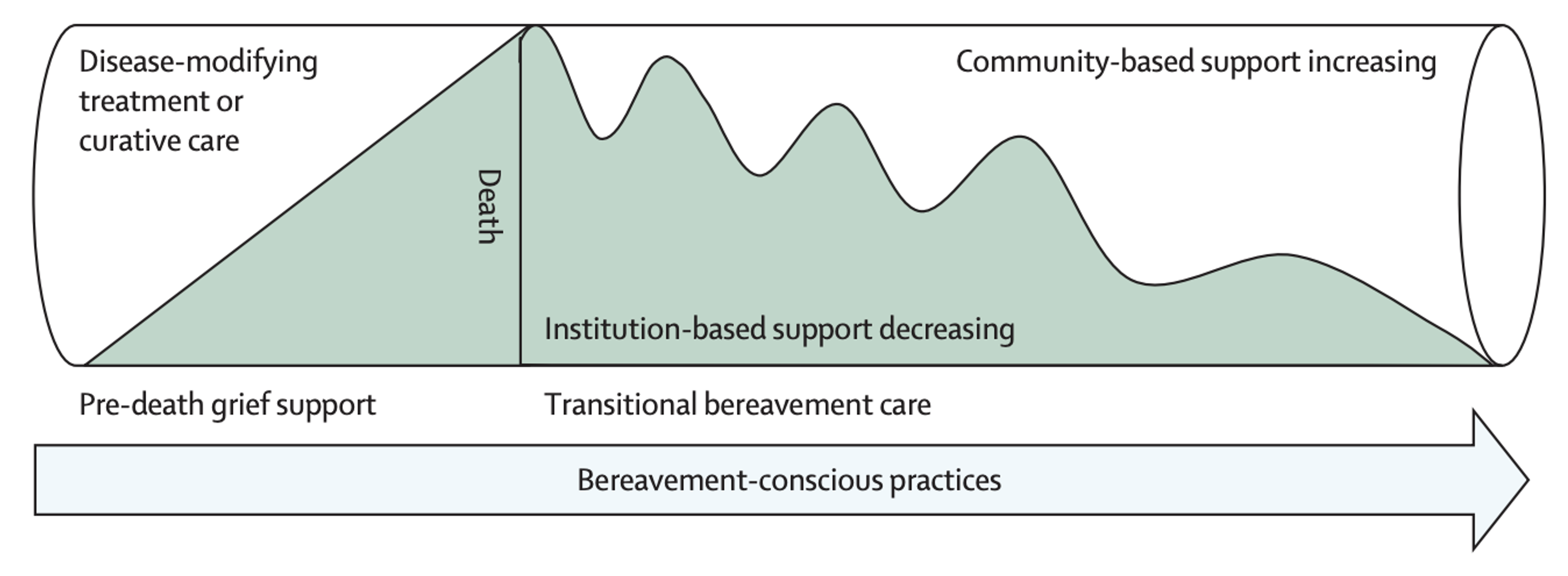
Diagram illustrating the Transitional Bereavement Care Model, showing the phases of care from pre-loss through post-loss, highlighting interventions, support mechanisms, and checkpoints to aid individuals in their grief journey. Figure: Conceptualising transitional bereavement care. From “Investing in bereavement care as a public health priority,” by W.G. Lichtenthal, K.E. Roberts, L.A. Donovan, L.J. Breen, S.M. Aoun, S.R. Connor, W.E. Rosa, 2024, April 1, The Lancet Public Health, 9(4), pp.e270-e274.
Establishment of institutional supports Development of community supports
Preventive bereavement care Health-care teams engage in bereavement-conscious practices, mindful of pre-death grief and the potential effect of end-of-life experiences on the bereaved family and of the importance of their relationships with the family of the dying patient. Compassionate communities are mindful of the emotional and practical needs of the family of the dying patient.
Ownership of bereavement care Institutions provide bereavement services and have dedicated personnel to educate clinicians and staff, conduct bereavement risk screening, reach out to bereaved individuals, develop bereavement resources, and provide counselling or grief support. Bereavement care centres are sustained in the community and bereavement care champions are identified for universal bereavement care within relevant organizations (eg, workplace, schools, religious institutions, or care facilities for older people)
Resource allocation for bereavement care Resources, including dedicated, funded personnel, are allocated to offer universal outreach and resources for all bereaved individuals (eg, condolence calls, memorial services, educational and web-based resources, and peer to peer and group support) and to provide targeted support to those in need. Bereaved stakeholders provide input to institutions, communicate needs, and liaise with groups in the community to identify barriers and facilitators to bereavement support and to determine needed resources, integrating intersecting social identities (eg, religion, ethnicity, or class)
Upskilling of support providers Bereavement care education is integrated into medical and health worker training programs; institutions provide continuing bereavement care education to all staff as well as dedicated bereavement specialists. A workforce of trained bereavement specialists in the community who are accessible (eg, accept insurance); community education about how to compassionately support the bereaved and increase grief literacy.
Implementation of evidence-based care Bereavement care is evidence based; research funding is available for the development of effective grief assessments, interventions, and training programs. Research is designed and implemented in partnership with grievers and communities to co-create best practices to support the bereaved.

logo--sylvester

NCI Designated

USNWR Cancer 2025-2026 Badge

Cancer Center of Excellence
Quick links
  • Appointments
  • Find a Doctor
  • Pay a Bill
  • Make a Gift
  • Insurance Plans Accepted
  • MyUHealthChart

Patient & Families
  • Cancer Treatments
  • Cancer Supportive Care
  • Your First Visit
  • Frequently Asked Questions
  • Nurse Navigators
  • Interpreter Services
  • Clinical Trials
  • International Patients
  • Medical Records
  • Price Transparency
  • Florida Health Finder
Research
  • Research at Sylvester
  • Research Programs
  • Research Labs & Faculty
  • Clinical Research Services
  • Shared Resources
  • Clinical Fellowship
  • Community Outreach Activity
About Sylvester
  • Why Choose Sylvester
  • NCI-Designated Cancer Center
  • Cancer Center of Excellence
  • Our History
  • Impact Reports
  • Mission, Vision & Values
  • Quality and Patient Safety
  • Leadership
  • Careers
  • Volunteers
  • For Media
  • Contact Us
  • Make a Gift

University of Miami Centennial Logo

Medical Disclaimer | Terms of Use | Privacy Statement | HIPAA Notice of Privacy Practices | For Employees
© 2025 University of Miami Health System. All rights reserved.